Apiculture Using Native Bees
What is Apiculture
Apiculture, or beekeeping, is the science and art of raising honeybees. Apiculture allows us to harvest bee products like honey, pollen, propolis, royal jelly and beeswax from beehives under controlled conditions, resulting in cleaner products and higher production than obtained by gathering from the wild.
| A beekeeper inspecting our hives in Lipa | Bees are quite tame, if handled properly! |
Traditional apiculture focuses on honey production, but the value of the industry has greatly increased thanks to the demand for commercial pollination services ("hives for rent"). Bees can greatly increase farm yield through their pollinating activities.
| Trigona hives ready for transport | Some crops that benefit from bee pollination |
We are specially promoting the culture of two native bee species, the Asian honeybee (Apis cerana) and the Philippine stingless bee (Trigona biroi) as more suitable to our tropical climate and conditions. Apis cerana is disease and pest resistant, specially against the varoa mite, and a fairly good honey producer.Trigona biroi produces more pollen and propolis, which fetch higher prices than honey, as well as being a better pollinator of local crops.
The Need for Bees
There is an increasing demand for honey and pollen from the health food market, both here and abroad. Health benefits of honey >>
Social bees, because of their sheer numbers, are more efficient pollinators compared to bats and birds. About 30% of all our food comes from crops pollinated by bees.
Local fruit trees such as banana, mango, coconut, coffee and cacao are favorite nectar sources of honeybees, and will do better when serviced by regular visits of domestic bees rather than relying on the haphazard presence of wild bees.
| Trigona hive in mango orchard, Bulacan; bees love mango nectar | Perfect mangoes - a sign of good pollination |
Fruit and vegetable yield can be increased by 30% to 70% by using bees as pollinators. See the table below for study results from the UPLB Bee Program:
Mean Yield Increase of Selected Crops Sunflower 30.00% Coconut (native San Ramon) 35-70% Calamansi 56.00% Watermelon 73.90% Cucumber 76.50% Upo 84.30% Patola 85.10% Pechay 90.00% Ampalaya 98.70% Domesticated bee hives can be rented out to plantation owners during flowering season, so the bees can encourage fruit and seed formation through their pollinating activities. Well-pollinated blossoms result in better-quality fruit.
In the USA alone the value of crops pollinated by honeybees is placed at US $24 billion and the value of commercial bee pollination at US$ 10 billion or about PhP 500 billion. For example, New York's apple crop requires about 30,000 hives.
Some agricultural investors have been hesitant to set up plantations here partly because there is a lack of commercial pollinating services, i.e. "bee rental" services.
Many valuable forest trees such as pterocarps, acacias and mangroves also rely on bees as pollinators. Thus bees help preserve the biodiversity of our endangered rain forests.
Opportunities in Beekeeping
- Honey and combs are sold as food supplement
- Honey and pollen are sold as health food
- Pollen is sold as feed supplement for fighting cocks
- Honey cider is a popular alternative remedy
- Honey and propolis are now popularly used in cosmetics.
- Beeswax is used in first-class scented candles
- Royal jelly is used in health supplements and Chinese medicine
- Nucleus colonies are sold to new clientele.
- Packaged hives can be sold abroad, specially the Middle East
- Bee venom is an ingredient in anti-rheumatic drugs
- Relatively low supply vs. relatively high demand in the local market.
- High consumer preference for local honey and bee products, despite higher prices of local honey.
- Increasing awareness to the many health benefits of hive products led to a high demand in Taiwan, South Korea and Japan for Philippine honey and other hive products.
- Droughts in Australia and contamination of chemicals in Chinese honey resulted in shortage of honey supply.
- Commercial pollination ("hives for rent") is a business practically unknown in the Philippines
- Some foreign investors have held back from establishing plantations here for lack of commercial pollination services
- At present, about 80% of all honey and other bee products consumed in the Philippines are imported.
- In 1985, total honey importation was 0.4 tons, mostly from the USA and Australia; by 1990, importation had risen to 79 metric tons.
- Domestic honeybee population has declined by as much as 80% since the late 1980's. There are now only about 6,000 commercial hives in the entire country.
| Honey Production | 110.65 mt/yr |
| Total peso value | 21.81M |
| Contribution to local demand | 36.66% |
| Total beekeepers | 474 |
| Total commercial hives | 6,263 |
| Honey exports | 40kg |
| Value | PhP 4,480.00 |
| Honey imports | 191 mt/yr |
| Value | PhP 38.2M |
| Apis mellifera colonies | 5,369, 434 keepers |
| Apis cerana colonies | 894, 40 keepers |
| Trigona biroi colonies | - no data - |
Employment and Small Business Opportunities
- Beekeeping is a highly suitable enterprise for small businesses
- Develops industries that cater to beekeeping, like equipment fabrication and carpentry
- Processing of bee products requires additional trained labor
- Training and employment opportunity for women, out of school youth, and other sectors
- Skilled beekeepers have opportunities to work in apiaries abroad
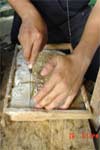
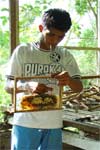
| A young beekeeper in training. | Former OFW now turned successful beekeeper |
 |
 |
||
| Beekeeping is a skilled craft that offers many opportunities for men and women alike. | |||
Since there are few qualified beekeepers, there is still plenty of opportunity in the field.
Part
One
What is Apiculture
The Need for Bees
Business Opportunities
Crop Yield Increase
Market for Bee Products
Local Industry Situation
Industry Data, August 2004
Business & Employment
Part Two
Why Apiculture
Why the Philippines
Why Native Bees
Part Three
Program Objectives
Apiculture Program
Industry Concerns
Bee Ecology
About Pollination
About Beehunting
About Varoa Mites